The Playful Cruelty of
Hsieh Chun-Te
The Playful Cruelty of Hsieh Chun-Te
by Dominique Païni
What struck me when I first saw Hsieh Chun-Te’s photographs was the atmosphere, the sense of a gathering storm that pervaded many of them. As if Hsieh was representing a postlapsarian world. Some of the compositions clearly indicate the performance of a violent action condemned by propriety and the rules of human society. It is nearly always a matter of punishment, of a body cast down on a symbolic field of thorns, of hanged bodies, of bodies abandoned in the indifference of our modern deafness, bodies drawn and quartered, bodies sexually punished, bodies that seem to be held up to public opprobrium. From Giorgione’s The Tempest to the prints of Gustave Doré, the storm is a manifestation of divine wrath.
The artist who dares to show such scenes of sacrifice is a visionary haunted by the disquiet that arises from the complicity between Eros and Thanatos. I had never before seen a scene of capital execution whose final act is a sexual act observed by the usual, gloomy witnesses of that terrible ceremony which legally terminates life (The Romance on the Stele, Raw series). What audacity, what derision to mix in this way the legalised transgression that consists in coldly taking away life with the approval of the court and the most beautiful of all human actions! It is indeed a ceremony, here, and all Hsieh Chun-Te’s work is ceremonial. Of which, more below.
To describe Hsieh Chun-Te’s works more precisely one would have to compare them to images that form an ensemble, like caprichos that go beyond caricature to describe the disasters of the world. The allusion to Goya here is quite deliberate, because this is the impression that these big photographic compositions make on me: a set of dreams of reasons bringing forth monsters, to echo the famous title that Goya gave to one of his works, a collection in which black and white, ugliness and beauty, purity and vice clash with each other. Hsieh offers a kind of photographic equivalent of these visions of the end of a decadent and corrupt humanity, visions traversed by winds that threaten to sweep away the ruins of a post-cataclysmal world.
Several aspects of Hsieh’s work also evoke the poetics of Georges Bataille, the cataclysmal character of which Pierre Klossowski described in terms that offer a troubling echo of Hsieh’s images: “[in Bataille] the ontological catastrophe of thought is merely the reverse of an apogee attained in what he calls sovereign moments: drunkenness, laughter, erotic and sacrificial effusion, experiences that characterise expenditure without compensation, a measureless prodigality, a loss without meaning, utility or purpose.” Klossowski was speaking here of “simulacra” in Bataille’s work.
With Hsieh we are fascinated by a prodigality in the staging of elements that are at once atrocious and delectable and measureless; fascinated by an erotic loss. Drunkenness, sacrifice and sometimes cruel humour: this is what these very disconcerting images are made of. The pose and attitude of these three women seen in a street in Shueigin (in the county of Kohu, in the southern part of Taiwan), in Homecoming Day, irresistibly evokes lingshi, that mythical Chinese torture known as “death by a thousand cuts,” which Bataille wrote about in his Tears of Eros – “that ecstatic and intolerable pain, the representation of which mixes religiosity and eroticism.” And it is the photographic focus that selects and points up what must be looked at in this ruined urban theatre, and in particular the bodily parts of these three vestals barring access to it, by emphasising one of their breasts, as if this optical adjustment was itself an incision.
The iconography of Hsieh Chu-Te reveals multiple borrowings and in turn borrows from several periods of art. The first thing that strikes us is this anachronism.
If we nevertheless set out to contradict this loss of bearings that Hsieh very deliberately engages in, in other words, if we go back in time, the family group (Family Portrait) taken in front of a house in the same town, Shueigin, a place that obsesses the artist, comes out of a tradition in Chinese art, and can be related to certain images from the twentieth century. At the Museum of Fine Arts in Taipei there is a plaque by Huang Tu-Shui which, it seems to me, belongs to the ancient Chinese tradition of rural images and constitutes a kind of iconographic predecessor of Hsieh’s visions. The peaceful nature of the relations between the children and the buffalos that Huang expresses in the gentle relief of this gypsum plaque has a correlative in the velvety black-and-white of Hsieh’s photographs. Hsieh does indeed have a very personal way with the zones of clarity and haziness in his prints, and the contrast between the bright, sunny foreground and the shadow of the house creates a depth comparable to what is conveyed by the delicate low relief.
But the strangeness of Hsieh’s work does not come from the unease provoked by a certain erotic cruelty so much as from the great diversity of his references, his extensive visual culture.
It would be easy, and verging on intellectual laziness, to speak of the sur-reality of these images, if not their surrealism. The word is overworked and hackneyed. And yet there is a kind of obviousness in the way the entwined couple so irresistibly evokes certain Surrealist motifs such as René Magritte’s The Lovers. Still, this echo is no ordinary quotation. Is it deliberate on the part of the artist? I doubt it. The entwined lovers could also originate –
that is, if we absolutely need to find roots for Hsieh’s imagination – in Goya, as I have already suggested. Georges Bataille, indeed, used an engraving in The Tears of Eros, as mentioned above, that can be considered as the infernal version of this twisted fusion of bodies. There
can be no doubt that Hsieh Chun-Te has encountered Bataille and Surrealist inspiration. A photograph by Hans Bellmer showing his disjointed doll on a bed of straw came to mind when I saw the disturbing image of that young woman suffering and exposed to the wounds of a torture of growths – The Tears of Tamsui River – growths as unnatural as Bellmer’s litter or the bedding of Marcel Duchamp’s Given.
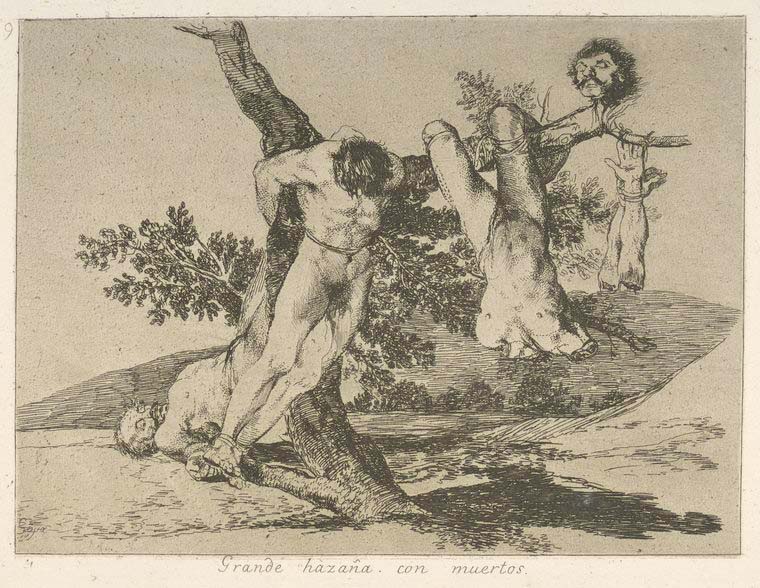
Goya’s influence reaches deep into Hsieh Chun-Te’s visual culture. At the start of this essay I spoke of the Caprichos and the Disasters. In the latter series, the print of the Great deeds against the dead offers a model for one of the recurring images of bodies that are
tortured, hung by the feet, the head fated to be buried forever, in the Raw series (Bitches). Yes, bodies are hanged in the apocalypse according to Hsieh Chun-Te. But one nevertheless hesitates between terror and a macabre irony.
Another thing that characterises Hsieh Chun-Te’s photographic theatres is the scope of their mise-en-scène. As with Joel-Peter Witkin, who is a few years younger than him, for Hsieh each photograph is the concluding act that comes after lengthy preparation. The choice of location, the sizeable team of assistants, the sets, utensils and furniture, the complex lighting, the costumes, the attention to the poses (in other words, the performance), bring them close to the mise-en-scène of cinema. And if I had to place this artist from Taiwan within a tradition and culture affording closer access to his world, it is to cinema that I would refer, and in particular Japanese cinema and its New Wave of the 1960s, which was so important for artists in the “region,” and of course to those of Taiwan, which had remained culturally permeable to Japanese influence.
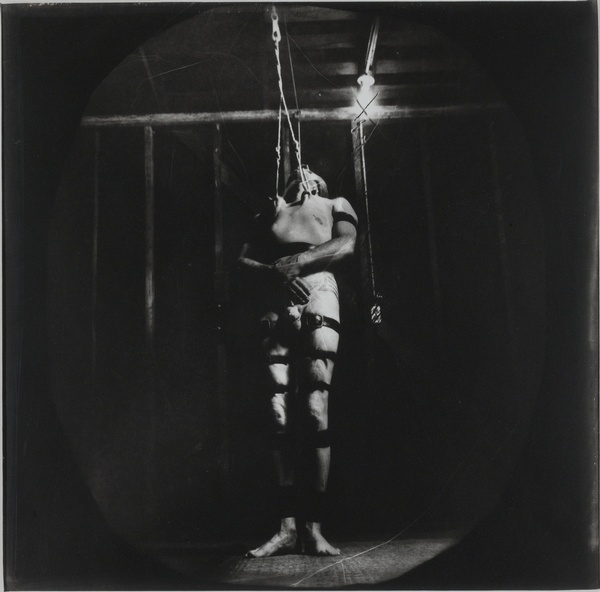
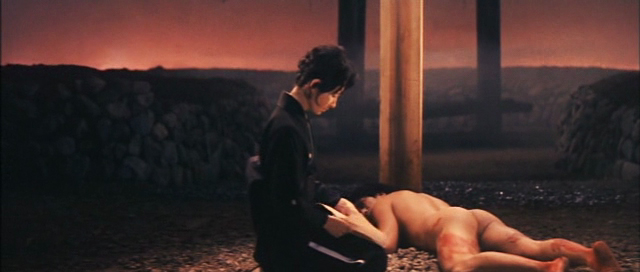
Beyond the simple title of the works presented here – and this is far from insignificant: Ceremony – I was greatly impressed by the distant echoes between the films by the master of modern Japanese cinema, Nagisa Oshima, and Hsieh’s mises en scène. And the slow, tragic conclusion of Oshima’s The Ceremony (1971) came to mind when I first saw the work of this artist who places such emphasis on social rituals and cruelty.
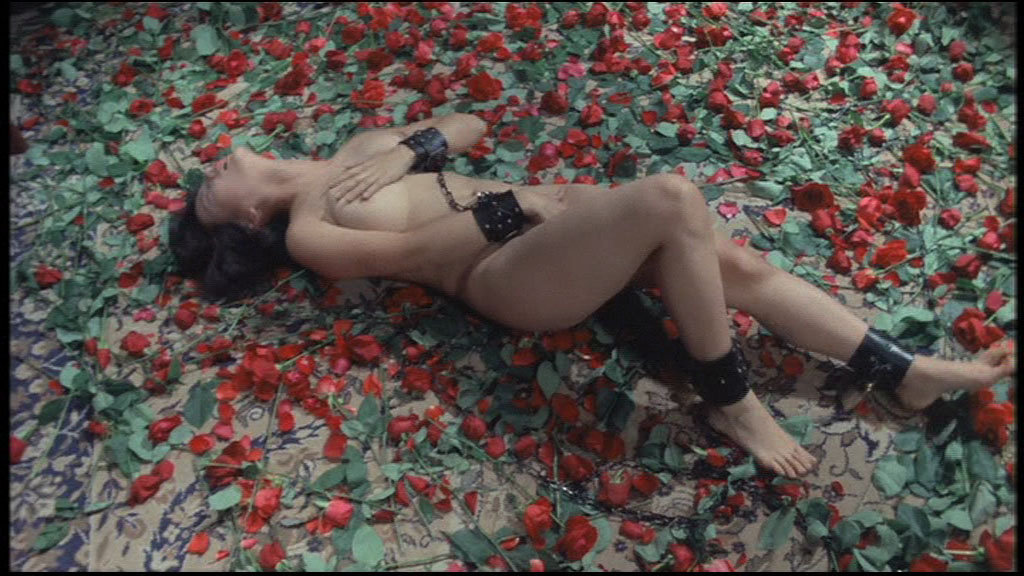
A tendency in Japanese cinema, a current considered as very erotic, which was very fashionable in those same years, produced by the Nikkatsu company, which inaugurated a series entitled Perverse Housewives (Danchi Zuma), offered some very intense images of female submission, and in particular one of the most famous films in that series, The Woman with Pierced Nipples by Shogoro Nishimura, where we see the main actress rolling around on a carpet of roses, her back wounded by the thorns.
In those days Koji Wakamatsu was the master of pinku eiga, a specifically Japanese cinematic genre that was considered erotic but had an aesthetic that was very much of the New Japanese Cinema. Wakamatsu’s work can seem disconcertingly close to Hsieh’s. I am thinking here of his remarkable film The Embryo Hunts in Secret, which was still given an X rating on its release in Europe in 2007. In one sequence, where a woman stands in a doorway, offering herself to a man, the light projected around her suggests a second image, an image
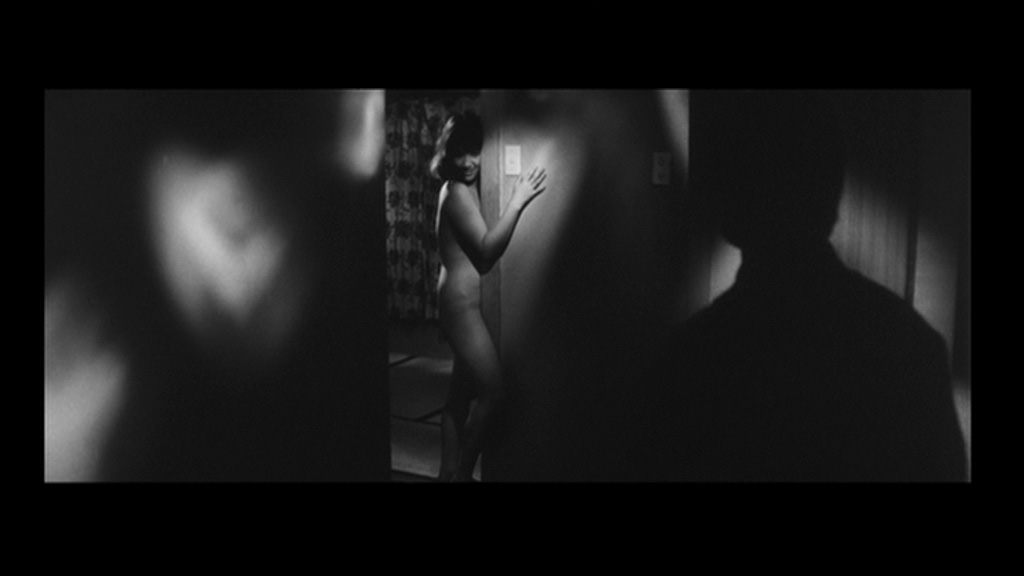
within the image, a subliminal image of another body inscribed in the matter of the image, like the one that, after looking for a while, we can make out in Hsieh’s photograph Flight in the Night. Similarly, the body is exhibited in Wakamatsu’s work in a way that brings to mind Hsieh’s Mirror.
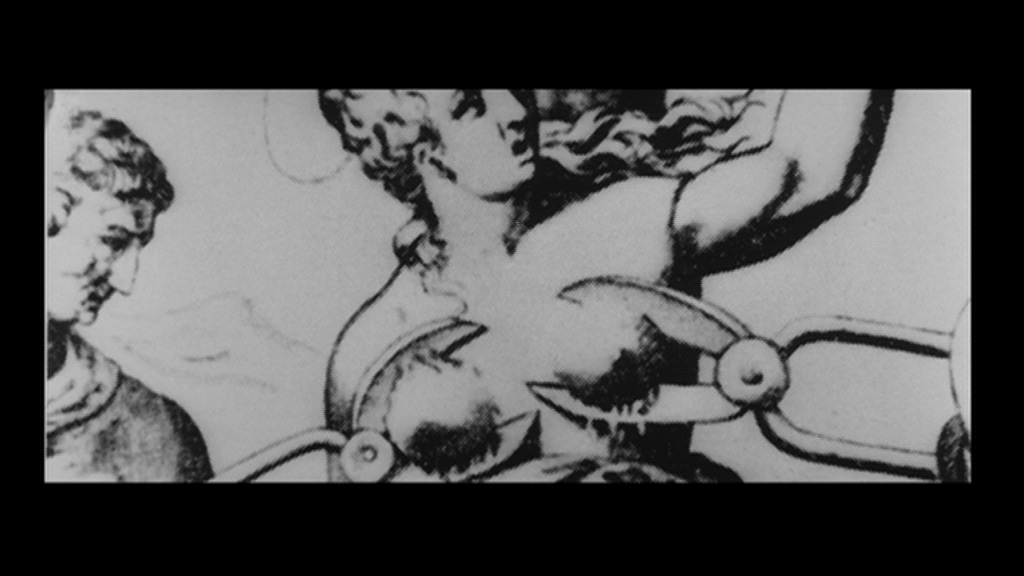
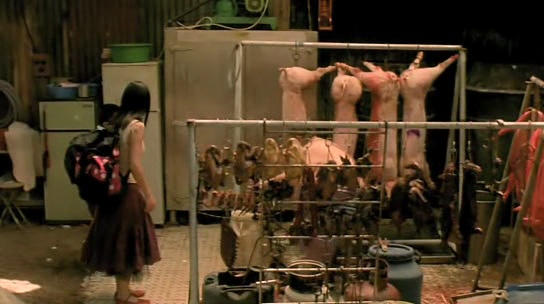
To put it differently, Hsieh’s originality lies in this alternation between several cultural references: classical Western painting, Surrealist ecstasy and modern Japanese cinema. This assemblage may seem extravagant and incoherent to those who know nothing about Taiwan, its identity concerns and the collage of cultural components that forms today’s island. It engenders work whose main concern, precisely, is to construct the coherence of an assemblage that does not exclude humour in its juxtapositions. One of the most impressive photographs is the staggering image of the hanging bodies of young women (Bitches, Raw series). Shocking eroticism aside, what also comes across here, in an untimely and provocative way, is Hsieh’s second passion: gastronomy. This installation irresistibly brings to mind those presentations of glossy Peking duck and glazed pigs, hanging from their legs in the windows of traditional Chinese restaurants, ready to be eaten. Once again, this extraordinary image refers to cinema, but this time to the Chinese cinema of Hong Kong. I have a vivid memory of a film by Fruit Chan from 2001, Hollywood Hong Kong, set in the professional world of food markets. It includes a sequence which confirms my feeling that the effects in each of Hsieh Chu-Te’s works offer a synthesis of cruelty and beauty, humour and tragedy: a playful cruelty.
CV Paini
Essential of his professional life was devoted to the diffusion of the cinematographic culture and the research of this most representative media of the 20th century. This specialization gives him a great knowledge of the visual arts of the 20th century and specially the plastic arts, which are profoundly influenced by the cinema.
In the 80’, he has directed some mythic cinema theatres of Paris (Studio 43, Le Bonaparte and Les Ursulines).
His opening to the art history brought him to the Musée du Louvre in the end of the 80’. He has produced several important series of television (Palettes, La Ville Louvre, etc.) with some future famous documentary film directors: Alain Jaubert, Nicolas Philibert.
In the 90’, he was the director of the Cinémathèque française which he has innovated.
Then he was named Directeur at the Centre Pompidou where he curated several multi-disciplinary exhibitions (.Roland Barthes, Samuel Beckett) and in parallel, several international shows, including Hitchcock et les arts (2001), Jean Cocteau, sur le fil du siècle (2003), Voyage(s) en utopie de Jean-Luc Godard (2006), La main numérique (2008 in France et 2010 on Taiwan), ABC, Art Belge Contemporain (2011 au Fresnoy, Lille.)
In 2006, he became the director of the Fondation Maeght, and his show, Le noir est une couleur, has attracted 91,000 visitors in three months.
He was also co-curator of Walt Disney show at the Grand Palais de Paris, 2006.
Dominique Païni is author of many texts in the reviews of art (Art Press, Les Cahiers du cinéma… ) and important books in the domain of the relations between the cinema and the other arts: (recently) Le temps exposé, le cinéma de la salle au muse, Ed. Cahiers du Cinéma 2002, L’attrait de l’ombre, 2007, L’Attrait des nuages, 2011, Editions Yellow Now.
He is now professor at the Ecole du Louvre.