Comments
· Photo
· Movie
· Exhibition
ten-ka
by Dominique Païni
In a previous series of photographic paintings entitled Raw, Hsieh Chun-Te staged bodies hindered, torn, crucified in the prospect of maintaining and recording a memory. In these large black and white images, this memory of the fundamental cruelty of insular identity (Taiwan) and of the erotic violence released by certain religious rituals made for an undertaking equivalent to a kind of painting of history.
The Tenky series gives a generic title to a new exhibition that turns away from the ambition of History. While keeping borrowing hybrid references from Western mythologies (Salome and Holofernes…) and an Oriental conception of the world, greater emphasis is now given to the planet’s tragic environmental destiny and to the cataclysms that threaten it -including, especially, those having man as its origin. From this mythological and philosophical register, Hsieh draws the figuration of his apocalyptic haunting, making the hypothesis that its fate is programmed by an irrebuttable cultural unconscious.
The Raw series used the variations of the photographic point to organize the elements of the representation into a hierarchy. Beyond the contours of the qualities of gray, the intermittence of the blurred and the clear-cut were laying down a perspective that’s as moral as it is spatial.
The Tenky series makes use of another figurative bias. Hsieh chooses from reality materials that will compete in the picture: the puffiness of the clouds and the oily flatness of the water, the reflection from a lake’s surface and the opacity of the rocks, the landscape devoid of any presence and the solitude of an animal, the calcined tree bark and the luminous epidermis of the exposed bodies… This goes to show the wrong track towards which Hsieh directs the interpretation of his images. The strength of its figuration, that sometimes confines to indecency and suggests a fascination with the “playful cruelty” of a Georges Bataille, is actually masking a formalist project whose opposition of materials and tensions between close patterns, according to the principles of oneiric collage, denotes a secret desire for abstraction. The latter is fought and denied to the extent of the lush and delirious composition of the images, but betrayed by the concerted alternating of the accentuated verticality and horizontality of their formats.
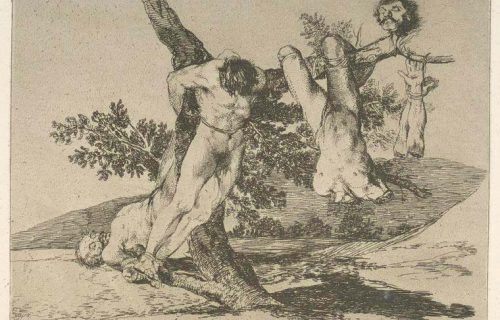
The recourse to color does not detract from the obsessions of an artist for whom the disasters of war by Goya became, to him, the disasters of progress and indifference towards the natural fate of the world. Also, color does suit incendiary terror even better. If contemplation of the planet in peril favors mineral reliefs and endless stretches of lakes, Hsieh aspires to the shelter of taking flight and hopes for the power of images to provide its vision by metamorphosing the rock’s heaviness into an evanescence of clouds.
(Translator: Patrick-Guy Desjardins)
Exhibition/Press
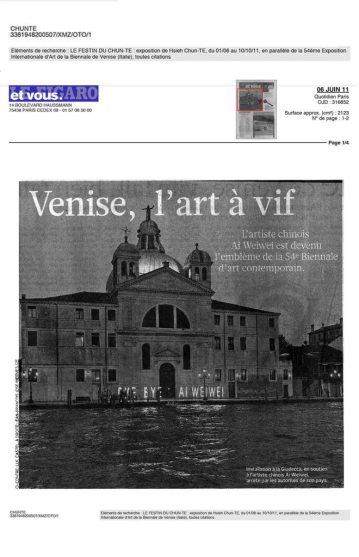
Venise
法文01_-660x1024-359x557.jpg "Noir festin à Venise")
Noir festin à Venise
Dominique Païni